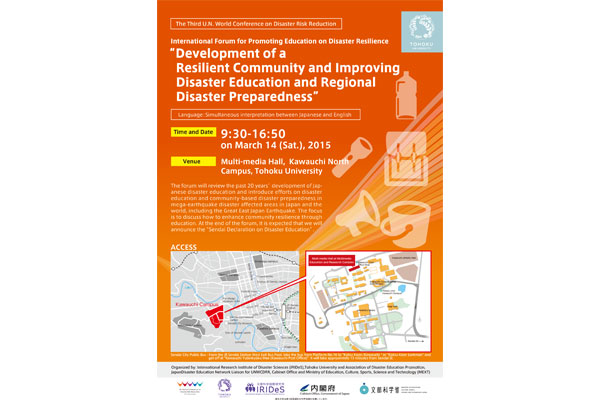



This symposium will review the past 20 years’ development of disaster education in Japan, and will introduce efforts in disaster education and community-based disaster preparedness in areas affected by mega-earthquake disasters around the world, including the Great East Japan Earthquake. The focus is on discussing how to enhance community resilience through education. The Sendai Declaration on disaster education will be announced at the symposium.
Program
09:30-09:35
Opening Remarks
Masaki Watanabe, Vice Chair, Japan Disaster Education Network Liaison for UNWCDRR
09:35-09:55
【Invited Speech】
“20 Years’ development of Japanese disaster education evolved through lessons learned from mega-earthquake experiences”
Yoshio Toda, Representative, School Safety Education Study Support Center
Part I
Learning from Tohoku: Experiences of the Great East Japan Earthquake and Tsunami in 2011
09:55-10:10
“Initiatives for enhanced disaster education by MEXT”
Masahiro Oji, Director, School Health Education Unit, Sports and Health Department, Ministry of Education, Culture, Sports, Science and Technology
10:10-10:20
“Damage to and recovery of the education sector by the Great East Japan Earthquake and Tsunami”
Takeshi Sato, Professor, IRIDeS, Tohoku University
10:20-10:35
“Human development for reconstruction and revitalization”
Shinya Morimoto, Supervisor, Iwate Prefecture Board of Education
10:35-10:50
“Efforts for disaster education in Miyagi Prefecture”
Yuji Misaki, Supervisor, Miyagi Prefecture Board of Education
10:50-11:05
“Education recovery and disaster education program by Fukushima Prefecture Board of Education: Program for radiation education”
Hiroki Abe, Teacher’s Consultant, Fukushima Prefecture Board of Education
11:05−11:20
“Remodeled disaster education in Sendai”
Takashi Konno, Supervisor, Sendai City Board of Education
11:20-11:30
“Disaster recovery education program in Ishinomaki-City, Miyagi”
Aiko Sakurai, Associate Professor, IRIDeS, Tohoku University
11:30-11:40
“Science delivery and the Gensai Pocket Yui Project”
Mari Yasuda, Research Associate, IRIDeS, Tohoku University
11:40-11:50
“KAKEAGARE JAPAN” Tsunami disaster risk reduction joint project among industry, government and academia”
Yoshi Abe, Research Associate, IRIDeS, Tohoku University
11:50−12:00
“Disaster education on earthquake and tsunami with use of Disaster Mitigation Card Game”
Team of Top Leader Development Program in Global Safety, Leading Graduate School Program, Tohoku University
“The Making of Kamado Bench”(Shiga Prefecture)
Yoshinori Tanaka, Teacher, Shiga Prefecture Hikone Technical High School
“Lone Cherry Tree of Life Project”(Hyogo Prefecture)
Yoko Nakajima, Representative, Art School Atelier Taiyo-no-ko
12:00-13:00
Lunch Break and Exhibition Tour (@first floor lounge space)
Part II
Learning from Disaster Education Practices in the World and Japan
13:00-13:10
Remarks
Yoshiaki Nanami, Counselor, Disaster Management Bureau, Cabinet Office
13:10-13:35
“Disaster education after the 2004 Indian Ocean Tsunami in Banda Aceh, Indonesia”
Samsul Rizal, Rector Syiah Kuala University
Khairul Munadi, Head, Tsunami and Disaster Mitigation Research Center
Muhammad Dirhamsyah, Head, Graduate Program in Disaster Science
13:35-14:00
“School Safety in China after the 2008 Sichuan Earthquake”
Linsheng Gu, Professor, and Executive Director, Institute for Disaster Management and Deconstruction (IDMR), Sichuan University-Hong Kong Polytechnic University
14:00-14:10
Comment by Mee Young Choi, Head, Education Sector Unit, UNESCO Jakarta Office
14:10-14:25
“Great ShakeOut Earthquake Drills: Awareness to Action”
Dr. Mark Benthien, Director for Communication, Education and Outreach, Southern California Earthquake Center(USA)
14:25-14:34
“Great ShakeOut drill through collaboration between government and civic organization”
Masahiro Hamada, Representative, Zama Disaster Volunteer Network
14:34-14:43
“Implementation of disaster education based on various hands-on activities”
Yoshinori Takahashi, Principal, Minami-Yoshinari Elementary School, Sendai-City
14:43-14:52
“We are fighters for future disaster risk reduction”
Yasuyuki Toba, Teacher, Hashikami Junior High School, Kesennuma-City, Miyagi
14:52-15:01
“Safe disaster measures for mamas” Program
Masumi Nishizato, Representative, “Asobi ma・senka” Morioka-City, Iwate
15:01-15:10
“The Study of earthquake and tsunami in Shinjo and regional cooperation”
Akira Tanimoto, Shinjo Junior High School, Tanabe-City, Wakayama
15:10-15:19
“Disaster education to protect the lives and health of everyone”
Takeshi Takigawa, Teacher, Togane School for Special Needs Education, Chiba
15:19-15:28
From “Easy Japanese” to “Disaster education”
Atsuko Sugimoto “Easy Japanese” Volunteer Group, Kyoto
15:28-15:43
“Implementation handbook for regional disaster resilience education”
Haruo Hayashi, Professor, Disaster Prevention Research Institute, Kyoto University
15:45-15:55
Break
Part III
The Sendai Declaration and Panel Discussion
15:55-16:40
Coordinated by Yoshiaki Yazaki, Advisor, National School Safety Educational Study
Panelists:
Haruo Hayashi, Chair, Implementation Committee for Disaster Management Education Challenge Plan
Masaki Watanabe, President, the Japanese Association of Safety Education
Naoshi Hirata, Chair, Association of Disaster Education Promotion
Fumihiko Imamura, Chair, Drafting Committee on Sendai Declaration
Tatsuya Fujioka, Vice Chair, Drafting Committee on Sendai Declaration
16:40-16:50
Announcement of Sendai Declaration and Closing Remarks
Fumihiko Imamura, Director and Professor, IRIDeS, Tohoku University and Chair, Japan Disaster Education Network Liaison for UNWCDRR
16:50-17:50
Exhibition Tour and Information Exchange @first floor lounge
18:00-20:00
Reception @Café couleur, Kawauchi Campus, Tohoku University